
Introduction
I remember the first time I sat down to read the book of Revelation. It was the summer of 1992—a pleasant Pennsylvania evening—sitting on the back patio of the small house where I spent my teenage years. That night, I read all twenty-two chapters in one sitting. Early on, I underlined a verse that encouraged me: “Blessed is the one who reads aloud the words of this prophecy…” (Rev. 1:3). Those words felt like a promise—that something good awaited anyone willing to step into this book.
But as I kept reading, I grew more and more confused—especially when I reached chapter 6. The imagery became overwhelming, the questions multiplied, and when I finished, I had only highlighted a handful of verses. That night marked both my introduction to Revelation and the limits of my confidence in it—a confidence that, for many years, did not grow much beyond that patio chair.
Part of the reason I read Revelation in the first place had to do with a movie I watched with my friends called A Thief in the Night, which focused on what theologians call the rapture—the belief that believers will be caught up to meet Christ in connection with a future tribulation. Passages like 1 Corinthians 15 and 1 Thessalonians 4 are often cited in support of this view. For the sake of time, we read just the words from 1 Thessalonians: “The Lord himself will descend from heaven… and so we will always be with the Lord. Therefore encourage one another with these words” (v. 16).
Because the word rapture does not appear in the Bible, many people encounter it through popular books and films, such as the Left Behind series. Those works helped popularize one particular way of reading prophetic texts—known as dispensationalism—which has had a significant influence on American evangelical churches. Dispensationalism is one of several interpretive approaches Christians have used to read Revelation, and it developed in the nineteenth century before spreading widely through conferences, study Bibles, and evangelical institutions.
My own thinking as a new Christian was deeply shaped by this framework. I share that not to critique my past, but to be honest about the lenses I brought with me as I opened this book—and the lenses many of us bring with us still.
It’s also important to know that dispensationalism is not the only way Christians have read Revelation. Throughout church history, believers have approached this book in several major ways: Preterist, Historicist, and Idealist readings. Faithful Christians have held each of these views while confessing the same gospel and worshiping the same Lord. That diversity of interpretation is not new. In fact, G. K. Chesterton once observed, “Though St. John the Evangelist saw many strange monsters in his vision, he saw no creature so wild as one of his own commentators.”[1]
How to Read Revelation Today
When I began my Revelation and Its Parallels project, I heard a simple statement—one I’ve never been able to trace to a single source—that has guided everything since: “Revelation cannot mean for us what it did not first mean for John and the first-century church.” That sentence has served as a compass for my book, my preparation for this sermon, and every message in this series.
I believe this principle is confirmed by Revelation 1:3, where we are given one of the clearest clues for how this book is meant to be read: “Blessed is the one who reads aloud the words of this prophecy, and blessed are those who hear, and who keep what is written in it, for the time is near.” This is the first of seven blessings in Revelation,[2] and it was originally spoken to seven real churches that existed in history. That blessing was not abstract or theoretical—it was given to ordinary believers gathered in local congregations.
To read Revelation rightly, we must first recognize that it is a letter written to seven churches. At the same time, it is also apocalyptic—from the Greek apokalypsis, meaning “unveiling.” Apocalyptic literature communicates truth through visions and symbolic language, revealing heavenly realities that are normally hidden from everyday sight. It invites us to question the assumption that appearances always reflect reality. What seems powerful and permanent by earthly standards may already be exposed as temporary when seen from heaven’s perspective.
What does that mean for us today? Revelation was written to first-century churches, but it was written for the church in every generation. It speaks across time, culture, and ethnic boundaries precisely because it first spoke clearly and meaningfully to the first-century church. And one of the clearest ways John teaches us to read this book is through the careful and consistent use of numbers—especially the number seven. Let me show you what I mean.
Reading Revelation Through Its Use of Numbers
There are a series of numbers that you must be aware of that are used throughout the Bible. When you are trying to figure out what those numbers mean, you MUST understand how those numbers are used throughout the Bible. So, the important numbers you need to be aware are 3, 4, 7, 10, 12, 24, 3½ (also 42 months, and 1260 days), and 1000. I have a whole chapter in the beginning of my book on the use of numbers in the book of Revelation, but for now let me highlight why this is important without getting into the weeds.
The Number Seven
The most predominant number used throughout the book of Revelation is the number seven. Many people associate seven with judgment—but Revelation begins with seven churches, not seven disasters (Rev. 1–3). Before Christ judges the world, He walks among His churches, knows them by name, commends their faithfulness, and calls them to endurance. Throughout Revelation, the number seven consistently communicates divine completeness—the fullness of God’s purposeful and perfect work.
There are not only seven churches, but also the seven Spirits of God. The seven Spirits are before God’s throne (Rev. 1:4) and are sent out into all the earth (Rev. 5:6). John is drawing on the imagery of Zechariah 4, where the emphasis is not on multiple spirits, but on the fullness of God’s Spirit at work. John is not describing seven distinct spirits, but the complete, sevenfold Spirit of the Lord. Each time we encounter this phrase, we should hear the echo of Zechariah 4:6: “Not by might, nor by power, but by my Spirit, says the LORD of hosts.”
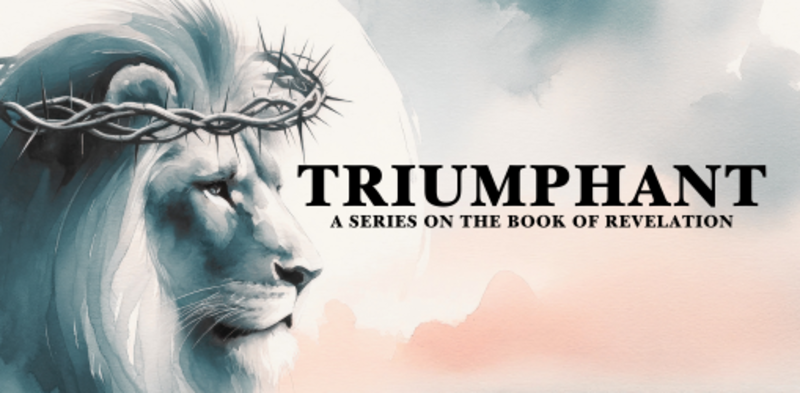
In Revelation 5, John is told, “Weep no more; behold, the Lion of the tribe of Judah… has conquered, so that he can open the scroll and its seven seals” (v. 5). Then something that happens often in Revelation occurs: John hears one thing, but when he turns to see, he sees something unexpected. In verse 6 he sees “a Lamb standing, as though it had been slain, with seven horns and with seven eyes.” Jesus is the Lamb. The seven horns do not describe physical features, but complete authority, since horns symbolize power. The seven eyes represent perfect knowledge—the Lamb fully knows His people and their suffering.
Throughout Revelation there is a scroll with seven seals, followed by seven trumpets and seven bowls of wrath. But here is what often surprises people: there are also seven blessings, sometimes called the seven beatitudes of Revelation. So let me ask this question: if the number seven is used everywhere else in the book to communicate a real and meaningful theological truth, why would we assume it functions differently when applied to a period of suffering often called the tribulation?
The number seven is even applied to evil powers—not to suggest their equality with God, but to show how evil attempts to mimic the completeness that belongs to God alone. Even then, its power is borrowed and its end is certain. We will return to the number seven again at the end of the sermon.
The Number Three
The number three is also an important number in Revelation. It does not appear as obviously or as frequently as the number seven, but it is woven throughout the book in meaningful ways. We see it immediately in Revelation 1:4, where John writes: “Grace to you and peace from him who is and who was and who is to come, and from the seven Spirits who are before his throne, and from Jesus Christ the faithful witness, the firstborn of the dead, and the ruler of kings on earth.”
In the Greek, John begins very simply and deliberately: “from the One who is, and who was, and who is coming.”[3] This threefold description refers to the Father and emphasizes His faithful presence across all of time—past, present, and future. Before Revelation introduces conflict, judgment, or suffering, it grounds the church in the identity of the eternal God.
Here’s the encouragement: before Revelation tells us what will happen, it tells us who God is. The book does not begin with fear, but with divine testimony—a settled assurance that the God who was faithful in the past is present now and will remain faithful in what is yet to come.
Before Revelation confronts the church with suffering, it anchors the church in the faithful, triune God who speaks with one unified voice.
The Number Four
After Revelation reveals the nature of God, it shifts focus to encompass all of creation and its relationship to Him. In the Bible, the number four frequently symbolizes the entirety of the created world—representing the total extent of God’s handiwork. By utilizing this number, Revelation emphasizes that John’s vision is not limited to a specific location or group, but instead embraces the whole of creation. We see this in Revelation 4 with the four living creatures who surround the throne of God (Rev. 4:6-8). Have you ever thought about the way they are described? The first living creature had the appearance like a lion, the second was like an ox, the third was like a man, and the fourth was like an eagle in flight. Taken together, the point is that the entire created order is made to worship the One who is on the throne. God rules over creation!
So when you read in Revelation about the four horsemen of the apocalypse, the four corners of the earth, the four winds, know that what is being referred to is the whole created world. One of my favorite places the number 4 is used is in Revelation 5:9-10 regarding the song that the four living creatures and the twenty-four elders sing: “Worthy are you to take the scroll and to open its seals, for you were slain, and by your blood you ransomed people for God from every tribe and language and people and nation, and you have made them a kingdom and priests to our God, and they shall reign on the earth.” Jesus ransomed a people for God 1) from every tribe, 2) from every language, 3) from every people, and 4) from every nation.
The Numbers Twelve and Twenty-Four
The number twelve represents the people of God. In the Old Testament, it refers to the twelve tribes of Israel, and in the New Testament, to the twelve apostles. Scripture consistently uses twelve to communicate that God’s people are known, formed, and established by His saving work. As Paul reminds us in Ephesians 2, God’s people are being built together on the foundation of the apostles and prophets, with Christ Jesus Himself as the cornerstone (Eph. 2:19–22).
In Revelation, the numbers twelve and twenty-four function together to identify the people of God as a unified whole. Twelve signals God’s covenant people, and twenty-four brings that picture to completion. In Revelation 4 and 5, John sees twenty-four elders seated around the throne—twelve representing God’s people under the old covenant and twelve under the new—together, at rest, and worshiping.
The emphasis here is not on calculation, but on reassurance. Revelation is not telling us how many belong to God; it is assuring us that all who belong to Him are gathered, secure, and present with Him—not one is missing.
The Number 1000
A final number worth mentioning is one thousand. Like the other numbers we’ve seen, Revelation does not use one thousand to satisfy curiosity or to function as a precise chronological measurement. Throughout Scripture, the number one thousand often communicates the all-encompassing scope of God’s work and promises.
We see this clearly in the Old Testament. Psalm 50:10 says, “For every beast of the forest is mine, the cattle on a thousand hills.” The point is not that God owns exactly one thousand hills and no more. The psalmist is using the number to say that everything belongs to God. One thousand functions as a way of expressing abundance and totality, not limitation.
That same use of the number helps us understand Revelation’s reference to 144,000. This number is not meant to be decoded, but understood. Twelve tribes multiplied by twelve apostles, multiplied by one thousand, forms a picture of the complete people of God, fully known, fully gathered, and fully secure. The emphasis is not on how many are counted, but on the assurance that no one is missing.
In the same way, when Revelation later speaks of a period described as “a thousand years,” the focus is not on constructing a timeline, but on affirming that God’s purposes are full, complete, and lacking nothing. In Revelation, one thousand does not tell us how long God reigns—it tells us how completely He reigns.
Conclusion
Now, back to the number seven. One of the most startling discoveries I made—one that truly floored me—came as I traced the biblical parallels shaping the book of Revelation. As I worked through both the Old and New Testaments, I began to see a repeated pattern suggesting that Revelation is intentionally structured in a particular way.
As I sketched out what I was seeing, that structure took shape as a heptagon, reflecting seven distinct yet interconnected perspectives. At the same time, I noticed that Revelation consistently moves toward a single, overarching theme: a new Eden, infinitely better than the first—where redemption reaches its climax in the new heaven and new earth. I also became convinced that the seven Jewish feasts help govern the movement of the book. As you can see in the diagram, Revelation is designed to be read from seven different vantage points, much like the four Gospels present Jesus from four complementary perspectives.
What this prepares us to see is that Revelation is not laid out like a straight timeline moving neatly from beginning to end. Instead, John repeatedly returns to the same redemptive realities—sometimes from the perspective of the church, sometimes from heaven, sometimes through judgment, and sometimes through worship—each time helping us see more clearly what is already true.
You may have noticed the small slinky on your seat this morning. I put those there intentionally. A slinky doesn’t move forward in a straight line—it advances by looping back over itself. And in many ways, that’s how Revelation works. The book moves forward by returning again and again to the same redemptive realities, each time from a different vantage point.
That’s what I mean when I talk about the recapitulatory nature of Revelation—and that’s what this seven-fold vantage point diagram is designed to help us see. Rather than presenting a single, forward-moving sequence of events, Revelation shows us the same story from seven different angles, each one reinforcing the same central truth: God reigns, the Lamb has conquered, and His people are secure.
This diagram isn’t meant to flatten Revelation or oversimplify it. It’s meant to help us see how its visions relate to one another—how seals, trumpets, bowls, and worship scenes are not competing timelines, but recurring perspectives on the same unfolding reality.
Revelation isn’t a puzzle to be solved, but a picture book meant to be seen. When we view it from heaven’s perspective, it becomes a source of assurance rather than confusion. Its purpose is not to challenge us with riddles, but to steady our faith, strengthen our hearts, and draw us into worship of the Lamb.
[1] G. K. Chesterton, Orthodoxy (London: John Lane, 1908), 21.
[2] On the seven beatitudes of Revelation, see 1:3; 14:13; 16:15; 19:9; 20:6; 22:7, 14
[3] Craig R. Koester, Revelation and the End of All Things, Second Edition (Grand Rapids, MI: William B. Eerdmans Publishing Company, 2018), 54.

