
I want to read you some quotes from some theologians and authors that you could have found or may even still be able to find in your local Christian books store:
Bob Wilkin: “One can be a believer in the Lord Jesus Christ and yet not be a disciple.”
Jesus: “You have abandoned the love you had at first.” (Rev. 2:4)
Joel Osteen: “God wants to increase you financially, by giving you promotions, fresh ideas, and creativity.”
Jesus: “Be faithful onto death, and I will give you the crown of life.” (2:10)
Robert Schuller: “Sin is any act or thought that robs myself or another human being of his or her self-esteem.”
Jesus: “You have some there who hold the teaching of Balaam...” (2:14)
Joseph Dillow: “A Christian can be carnal, even persistently so, and still be saved.”
Jesus: “You tolerate that woman Jezebel...” (2:20)
Joseph Prince: “The bottom line is that the Holy Spirit never convicts you of your sins. He NEVER comes to point out your faults.”
Jesus: “You have the reputation of being alive, but you are dead.” (3:1)
Kenneth Copeland: “God’s will is for you to prosper in every way—spiritually, physically, and financially.”
Jesus: “You have but little power, and yet you have kept my word.” (3:8)
Norman Vincent Peale: “Believe in yourself! Have faith in your abilities! Without a humble but reasonable confidence in your own powers you cannot be successful or happy.”
Jesus: “You say, ‘I am rich... I need nothing,’ not realizing that you are wretched, pitiable, poor, blind, and naked.”
With each of the seven letters, Jesus repeats the same four words: “The one who conquers...” And then he follows up those words with some promises:
- “The one who conquers… I will grant to eat of the tree of life, which is in the paradise of God” (Rev. 2:7).
- “The one who conquers… I will give you the crown of life, and you will not be hurt by the second death” (Rev. 2:10–11).
- “The one who conquers… I will give some of the hidden manna, and I will give him a white stone, with a new name written on the stone” (Rev. 2:17).
- “The one who conquers… “I will give authority over the nations, and I will give him the morning star” (Rev. 2:26–28).
- “The one who conquers… will be clothed in white garments, and I will never blot his name out of the book of life, but I will confess his name before my Father and before his angels” (Rev. 3:5).
- “The one who conquers… I will make him a pillar in the temple of my God, and I will write on him the name of my God and my own new name” (Rev. 3:12).
- “The one who conquers… I will grant him to sit with me on my throne” (Rev. 3:21).
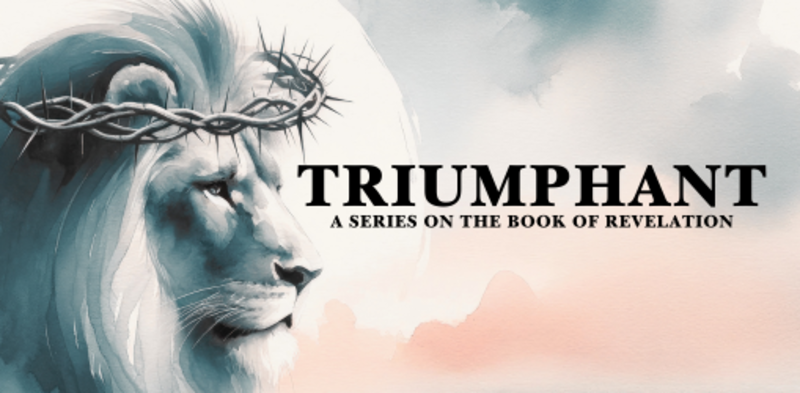
As you may know, the title of this sermon series captures the central theme of the book of Revelation—a theme that can be summarized in a single word: Triumphant. But what does it mean to be triumphant? Jesus answers that question with four simple words: “the one who conquers.” So, the two questions before us this morning are: 1) What does it mean to “conquer”? and 2) What is promised to those who conquer?
What does it Mean to Conquer?
Let me begin by explaining what our Lord does not mean by these four words. Conquering does not mean that saying a prayer or repeating what is often called “the sinner’s prayer” guarantees salvation. It does not mean that God will prosper you financially or physically. It does not mean that your self-esteem will remain untouched. It does not mean that becoming a “Christian” allows you to live with unrepentant sin without fear. It does not mean that you can be wrong about Jesus without consequence. It does not mean that you will be free from suffering in this life. And it certainly does not mean that you can rely on your own strength.
So, what then does it mean to conquer?
If our time in Revelation has not made this clear enough, let me point you to a verse that stands at the very center of John’s apocalyptic masterpiece—a verse that captures the theme of the entire book: “And they have conquered him by the blood of the Lamb and by the word of their testimony, for they loved not their lives even unto death” (Rev. 12:11, ESV). The Berean Standard Bible puts it this way: “They have conquered by the blood of the Lamb and by the word of their testimony. And they did not love their lives so as to shy away from death.”
Who did they conquer? They conquered the great dragon—Satan himself—who is called the deceiver and the father of lies. The apostle Paul speaks of this same reality in Romans 16:20: “The God of peace will soon crush Satan under your feet.”
But how is this possible?
It is possible, first and foremost, because of what Jesus accomplished through the incarnation. The eternal Son of God—fully God from all eternity—became fully man, being born of a virgin. He entered our world for this purpose: to accomplish redemption, to secure the forgiveness of sins, and to bring about the final defeat of sin, Satan, and death. However, the way Jesus secured the victory was not the way His disciples—or anyone else—envisioned it.
When Jesus entered Jerusalem for the final week before His crucifixion, He did so riding on a colt while the crowds spread their cloaks and palm branches on the road ahead of Him. They shouted: “Hosanna! Blessed is he who comes in the name of the Lord! Blessed is the coming kingdom of our father David! Hosanna in the highest!” (see Mark 11:1-10). The crowds rightly believed they were welcoming the promised King, but by the end of the week, some of their voices would fall silent while others would cry out, “Crucify Him!” (Mark 15:12-13).
Why? Because they misunderstood why Jesus came. They misunderstood what it meant for Him to conquer.
The crowds believed their greatest need was for the promised King to overthrow Rome. In their minds, there was no greater tyrant than the Roman Empire. But what they failed to see was that a far greater tyrant ruled over them—their own sin. Their greatest need was not political deliverance, but reconciliation to a holy God, because their sin demanded His righteous wrath.
They had celebrated the Passover year after year, but they missed what it pointed to. That feast was never an end in itself—it was a signpost. It pointed beyond itself to a true and better Lamb—the Lamb of God—who would take away the sin of the world. Jesus was clear about how He would conquer, but because the crowds could not see past Rome, a suffering Messiah was not on their radar. Even His disciples struggled to understand that the Lamb of God had to suffer and die by way of the cross before there would ever be the Crown. Isaiah 53 prophesied long ago:
He was oppressed, and he was afflicted, yet he opened not his mouth; like a lamb that is led to the slaughter, and like a sheep that before its shearers is silent, so he opened not his mouth.... Yet it was the will of the Lord to crush him; he has put him to grief; when his soul makes an offering for guilt, he shall see his offspring; he shall prolong his days; the will of the Lord shall prosper in his hand.
Jesus spoke plainly that this is what He came to do. On the way to Jerusalem shortly before Palm Sunday, He could not have been clearer: “See, we are going up to Jerusalem, and the Son of Man will be delivered over to the chief priests and the scribes, and they will condemn him to death and deliver him over to the Gentiles. And they will mock him and spit on him, and flog him and kill him. And after three days he will rise” (Mark 10:33-34).
Jesus conquered by living the sinless life we could never live and by dying the death under the wrath of God that we all deserved. He did not conquer by taking the lives of His enemies, but by giving His life to reconcile sinners to God. The Lion of the tribe of Judah has conquered—but He conquered as the Lamb who was slain (see Rev. 5:5–6). This is why all of heaven rejoices: “Worthy is the Lamb who was slain, to receive power and wealth and wisdom and might and honor and glory and blessing!” (Rev. 5:12).
So how do we conquer? The answer is found in the very verse we just read: “And they have conquered him by the blood of the Lamb and by the word of their testimony, for they loved not their lives even unto death” (Rev. 12:11). Do not miss what this verse is saying! It does not describe a different kind of victory than the one Jesus secured, but shows that we conquer by the blood of the Lamb and by the word of our testimony.
First, we conquer “by the blood of the Lamb.” Our victory is not based on our strength or effort, but entirely on what Jesus has already accomplished. The victory was won at the cross—not by us, but for us. Just as we are saved by Christ alone, we conquer by trusting that what He did was enough and that His righteousness is all we need.
Second, we conquer “by the word of our testimony.” In the book of Revelation, our testimony includes not only what we say but also the way we live in light of what we believe about Jesus. To confess Jesus as both Lord and Savior means living our lives based on that conviction, regardless of the cost. The word of our testimony is standing firm—refusing to compromise, refusing to bow before idols, and refusing to remain silent when the world demands our allegiance over Jesus.
Third, we conquer by “not loving our lives so as to shy away from death (BSB).” To conquer is not to avoid suffering, but to remain faithful through it. To conquer is to value Christ above comfort, above safety, and even above life itself. The world says, “Preserve your life at all costs.” But Jesus says, “Whoever would save his life will lose it, but whoever loses his life for my sake will find it” (Matt. 16:25).
I believe that when we consider these three things and apply them to our lives, we will regain the love we have abandoned, face suffering while holding onto hope, strengthen our resistance to compromise, see the emptiness of sexual sin, and care less about what others think of us. We will be less impressed by the powers of this world, and we will find ourselves more drawn to abide in Jesus as the source of our satisfaction and joy.
And this is where everything begins to come into focus. Because if this is what it means to conquer—if conquering means trusting in the blood of the Lamb, holding fast to our testimony, and remaining faithful even unto death—then we must ask: what is promised to those who conquer?
What is Promised to Those Who Conquer?
Before we examine what is promised to those who conquer, let me show you something you might not have noticed before. Often, Revelation 2–3 is treated separately from the rest of the book, but remember what I shared with you at the start of this series about how I believe Revelation is structured. Do you remember the chart I showed you in my first sermon? If you’ve forgotten, let me show it to you again.
There are seven vantage points through which John’s apocalypse is structured, each looking forward to the promise of a resurrected and renewed heaven and earth. Each of these vantage points—whether it is the churches, the seals, the trumpets, or the bowls—is not telling a different story, but the same story from different angles. They all move toward the same goal: Revelation 21 and 22—the new heaven and the new earth.
Every cycle in Revelation is pulling us toward the same promise: that God will bring His people all the way home. This is where it all comes together, because the promises Jesus gives to those who conquer in Revelation 2 and 3 are the very realities we see fulfilled at the end of the book.
In closing, let me show you what it is that we are promised and how Revelation 2–3 points us to the inheritance that is ours in Jesus.
To the one who conquers, He promises access to the tree of life (Rev. 2:7)—a promise fulfilled when we see that tree again in the new creation (Rev. 22:2). To the one who conquers, He promises that they will not be hurt by the second death (Rev. 2:11)—a reality confirmed when death itself is finally destroyed (Rev. 20:14; 21:8).
He also promises hidden manna (Rev. 2:17)—true and lasting satisfaction in God's presence; authority to reign with Him (Rev. 2:26–28)—a promise fulfilled when the saints reign forever and ever (Rev. 22:5); and white garments (Rev. 3:5)—symbolizing purity, victory, and belonging, again seen in the glory of the redeemed (Rev. 22:14).
And more still: to the one who conquers, He promises that they will be a pillar in the temple of God (Rev. 3:12)—a permanent place in His presence, where they will never go out again; and that they will sit with Him on His throne (Rev. 3:21)—sharing in His rule, in His kingdom, forever.
Do you see how every promise made to those who conquer is fully fulfilled at the end of Revelation? This fulfillment is not due to our strength, but because the Lamb has conquered on our behalf. Those who follow the Lamb may be stripped of everything this world offers—status, possessions, even life itself—but in Christ, they gain everything. Their inheritance is nothing less than the fullness of God’s kingdom, eternal life, and everlasting joy. What is lost here pales in comparison to the glory that awaits; in Christ, they become heirs of all things.

