
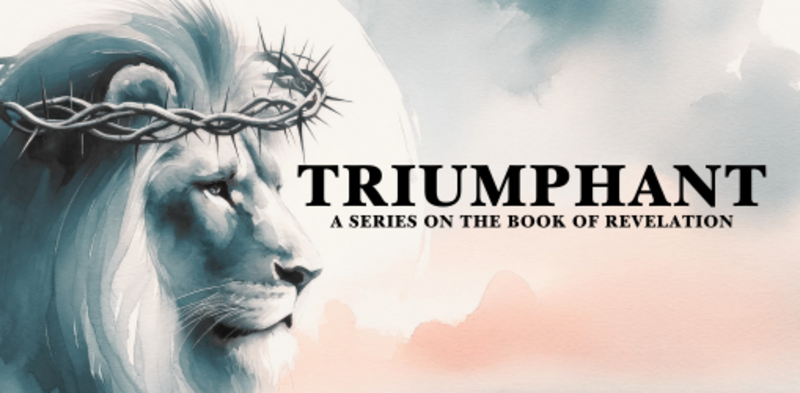
As we turn our attention to Revelation 10, I am reminded yet again of God's perfect timing and my absolute need of Him. I can think of no better passage for us to consider just five days after Election Day.
This past Tuesday, November 3, Americans went to the polls for the midterm elections. As you might imagine, the results generated some interesting reactions. Some are celebrating, while others are convinced our country is headed for disaster. Conservative Laura Loomer declared, “I hate to say it, but America is over.” Meanwhile, liberal Bette Midler had a very different reaction: “I am OVERJOYED! What a great, great night! Thank you, America! You’ve saved your beloved country!!”
Now, because of where we live, I'm betting most in this room are a bit discouraged with the election results. But whether you're celebrating or concerned about what they might mean for our country, I want to ask you a question: “Did anything happen this past Tuesday that changed who is sitting on the throne in heaven?”
I am not asking this to discount the importance of voting or to suggest that we ought to be passive in our civic responsibilities or prayers for this great nation. Rather, I want to remind all of us who have been born again that our citizenship belongs to a very different kingdom. Psalm 2 reminds us that while the nations rage and their rulers plot, God has already installed His King, Jesus Christ, who will rule the nations with a rod of iron (Ps. 2:1–9; Rev. 19:15).
With that in mind, we come to Revelation 10, where John is given another remarkable vision. And brothers and sisters, what we are about to see reminds us once again that regardless of what happens here on earth, the Lamb still reigns as King of kings and Lord of lords!
The Image of the Strong Angel (vv. 1-4)
The question before us, and one that has divided pastors and theologians, is this: Who is this “mighty” or “strong” angel? This is the second time John has introduced us to a mighty angel in Revelation. While we are not told whether these angels belong to a particular rank or order, John's description suggests that they may represent a distinct category of heavenly messengers. What makes this especially interesting is that each of their three appearances occurs at a significant turning point in Revelation.
The first mighty angel appears in Revelation 5:2, where he asks, “Who is worthy to open the scroll and break its seals?” Here in Revelation 10:1, another mighty angel announces that the mystery of God is about to be fulfilled. And in Revelation 18:21, a third mighty angel portrays Babylon's final destruction by throwing a great millstone into the sea. Do you see the progression? Each plays a particular role in revealing God's sovereign purposes: the unveiling of His plan, the certainty of its fulfillment, and the ultimate vindication of His people.
Because of the way this angel in Revelation 10 is described, some respected pastors and theologians believe that he is none other than Jesus Christ. However, I have three problems with that view. First, nowhere else in Revelation does John identify Jesus as an angel. Throughout the book, Jesus is presented as the Lamb of God, the One worthy to open the scroll, and the King of kings and Lord of lords. Second, John consistently distinguishes Jesus from the angels who serve Him. Jesus accomplishes God's redemptive purposes, while the angels announce and carry out His commands. Third, in verses 5–6, this mighty angel raises his right hand toward heaven and swears by the One who lives forever and ever, the Creator of heaven and earth. Now, if this angel is Jesus, why would He swear an oath by the authority of the One who created heaven and earth, rather than by His own authority?
So, what are we to make of all the divine imagery associated with this angel? The strong angel's radiant appearance reminds us of Moses, whose face shone after spending time in the presence of God (Exod. 34:29–35; cf. 2 Cor. 3:7–18). Just as Moses reflected God's glory, I believe this mighty angel is reflecting the glory of Christ, whose own face John describes as shining like the sun (Rev. 1:16; cf. Matt. 17:2). Even the holy angels cannot remain unaffected by the glory of His presence!
Everything about this angel reminds us of the faithfulness of God and that all His promises find their “Yes” and “Amen” in Jesus Christ (2 Cor. 1:20). The rainbow over his head reminds us of God's promise to Noah that He would never again destroy the earth by a flood (Gen. 9:11–17; cf. Rev. 4:3). But brothers and sisters, there is a far greater judgment coming, and there is a far better shelter from the tsunami of God's wrath than Noah's ark! Through the cross of Jesus Christ, we have been rescued from the judgment we deserve, and there is now no condemnation for those who are in Christ Jesus (Rom. 8:1)!
Just as the cloud and pillar of fire led Israel through the wilderness for forty years and reminded them of God’s presence, the cloud wrapped around the mighty angel and his legs like pillars of fire remind us that Jesus will never leave us or forsake us (Exod. 13:21–22; Heb. 13:5). But unlike Israel, whose journey led them to the Promised Land, we are being led to something infinitely better: the heavenly city God has prepared for His people (Heb. 11:13–16; 13:14).
Notice where the angel plants his feet. His right foot rests on the sea, from which the first beast will emerge, while his left foot rests on the land, from which the second beast, the false prophet, will emerge (Rev. 13:1, 11). To stand upon something can symbolize authority or dominion over it. But it is not ultimately the angel who exercises this authority over the sea and land. It is the One he represents, the One whom Paul describes when he writes, “For by him all things were created, in heaven and on earth, visible and invisible, whether thrones or dominions or rulers or authorities—all things were created through him and for him” (Col. 1:16).
In his hand is a little scroll that John will soon be instructed to eat. His voice is like the roar of a lion, reminding us of what was announced following the question of the first mighty angel: “Weep no more; behold, the Lion of the tribe of Judah, the Root of David, has conquered, so that he can open the scroll and its seven seals” (Rev. 5:5). As a servant and herald of Christ, this second mighty angel reflects the Lamb's sovereignty over all creation, including the two beasts that will emerge from the sea and the earth.
As for the seven thunders that respond to the angel's roar, I am not certain what they represent. But there is an interesting parallel in Psalm 29 that I want you to see. Seven times in verses 3-9, David refers to the voice of the LORD. Listen to how he describes the power and majesty of God’s voice:
The voice of the Lord is over the waters; the God of glory thunders, the Lord, over many waters. The voice of the Lord is powerful; the voice of the Lord is full of majesty. The voice of the Lord breaks the cedars; the Lord breaks the cedars of Lebanon. He makes Lebanon to skip like a calf, and Sirion like a young wild ox. The voice of the Lord flashes forth flames of fire. The voice of the Lord shakes the wilderness; the Lord shakes the wilderness of Kadesh. The voice of the Lord makes the deer give birth and strips the forests bare, and in his temple all cry, “Glory!”
Seven times David describes the voice of Yahweh, and here in Revelation 10, John hears seven thunders speaking. While we are not told what they said, there is no mistaking the power and majesty associated with the voice of God. And yet, John is told to seal whatever was said. Brothers and sisters, what a great reminder that while God has revealed everything we need to know, He has not revealed everything there is to know—a reminder of Deuteronomy 29:29, “The secret things belong to the Lord our God, but the things that are revealed belong to us and to our children forever, that we may do all the words of this law.”
There are two sets of “words” from the mighty angel we need to consider.
The Words of the Strong Angel (vv. 5-11)
The thunder in Revelation is also associated with God's righteous judgment upon the wicked (see Rev. 8:5; 11:19; 16:18). Robert Mounce offers an interesting explanation for the seven thunders when he writes, “It is more plausible that the seven thunders, like the seals and trumpets, formed another series of warning plagues. The adamant decision of the human race not to repent (9:20–21) would render another series useless.”1 In other words, given humanity's refusal to repent despite the judgments already experienced, another series of warning judgments would accomplish nothing. Their hearts have become so hardened that even the judgments of God will not turn them from their rebellion.
After John is told to seal up what the seven thunders have spoken, the mighty angel raises his right hand toward heaven and swears by the Almighty that there will be no more delay. Think about what this means for those who have suffered and died because of their faithfulness to Jesus Christ! Remember the cry of the martyrs in Revelation 6:10: “O Sovereign Lord, holy and true, how long before you will judge and avenge our blood on those who dwell on the earth?” Here in Revelation 10, we are given another assurance that their cry has not gone unheard. God's appointed time is approaching, and His purposes will be fulfilled: “And the angel whom I saw standing on the sea and on the land raised his right hand to heaven and swore by him who lives forever and ever, who created heaven and what is in it, the earth and what is in it, and the sea and what is in it, that there would be no more delay” (Rev. 10:5–6).
God has spoken! His Word is sure, and all that He says He will do, He indeed does! The seventh trumpet represents the Day of the Lord, when Christ comes as the King of kings and Lord of lords. We are told in Revelation 10:7 that in the days of the seventh trumpet call, the mystery of God will be fulfilled, “just as he announced to his servants the prophets.” And as Jesus said in Matthew 24 when describing the end of the age, “Heaven and earth will pass away, but my words will not pass away” (v. 35). I believe this is what John means by the “mystery of God”—the culmination of all God's redemptive purposes at the end of the age.
What God has promised, God will accomplish!
So, what are we to make of the little scroll? First, it is not to be confused with the scroll that Jesus alone is worthy to open. Remember the first interlude in Revelation 7, where we encountered the 144,000, representing the redeemed people of God, both Jews and Gentiles? Here in the second interlude, our attention again turns to God's people, particularly their role in a world that worships the beast.
The voice from heaven instructs John to take the little scroll from the angel's hand. And after taking it, notice what he is told: “Take and eat it; it will make your stomach bitter, but in your mouth it will be sweet as honey” (v. 9).
There is an important parallel here with Ezekiel 2:8–3:3, where God commands the prophet to eat a scroll that tastes as sweet as honey, even though the message he is called to proclaim is one of judgment. The psalmist describes God's Word in much the same way: “How sweet are Your words to my taste! Yes, sweeter than honey to my mouth!” (Ps. 119:103). Jeremiah likewise declares, “When Your words came, I ate them; they were my joy and my heart's delight” (Jer. 15:16, NIV). And here in Revelation 10, John is instructed to do something similar. Before he can proclaim God's message, he must first take it in himself. Only then is he told that he must prophesy again concerning “many peoples, nations, languages, and kings” (Rev. 10:11).
This is not the first time John was commissioned to proclaim the Word of God to the nations. Many years before his exile on the island of Patmos, Jesus commanded him and the other disciples: “Go therefore and make disciples of all nations, baptizing them in the name of the Father and of the Son and of the Holy Spirit, teaching them to observe all that I have commanded you. And behold, I am with you always, to the end of the age” (Matt. 28:19–20). That calling came at a tremendous cost to the disciples! John is reminded that while God's Word is sweet to those who worship the Lamb, it will be received with bitterness by many who reject Him.
And brothers and sisters, that same calling belongs to us! Like John and the prophets of old, we are called to proclaim His Word to a world that desperately needs to hear it. The message that brings us joy and hope is often met with rejection and hostility from those who refuse to submit to Christ. And as we will see in Revelation 11, the two witnesses experience that very hostility. Yet their story does not end in defeat. God raises them to life, reminding us that no amount of opposition can prevent Him from accomplishing His purposes.
Can I be real with you for a moment? What Revelation 10 reminds us of is that the world does not need more or fewer Republicans or Democrats. What the world needs is more Christians who have been in the presence of the Lamb! Christians whose lives have been so shaped by His Word that others can see the difference. Jesus said, “If you abide in my word, you are truly my disciples, and you will know the truth and the truth will set you free” (John 8:31–32). What matters most is not which political party you belong to, but who it is that you belong to! And listen to what Jesus says in John 15:4: “Abide in me, and I in you. As the branch cannot bear fruit by itself, unless it abides in the vine, neither can you, unless you abide in me.”
Brothers and sisters, when we abide in Jesus and His Word, it ought to be evident in our speech, behavior, and the way we live. People ought to be able to tell that we have been with the Lord because His character is being reflected in our lives. Some will be drawn to Christ because they see something of His beauty in us, while others will respond with hatred and hostility. Jesus warned us of this very thing: “If the world hates you, know that it has hated me before it hated you. If you were of the world, the world would love you as its own; but because you are not of the world, but I chose you out of the world, therefore the world hates you” (John 15:18–20). If the world hates you, make sure it is for the right reasons. If people are attracted to your life, be sure that it is because they see Jesus in you.

